Coulomb's Law Practice Problems with Answers (Class 12, JEE & NEET)
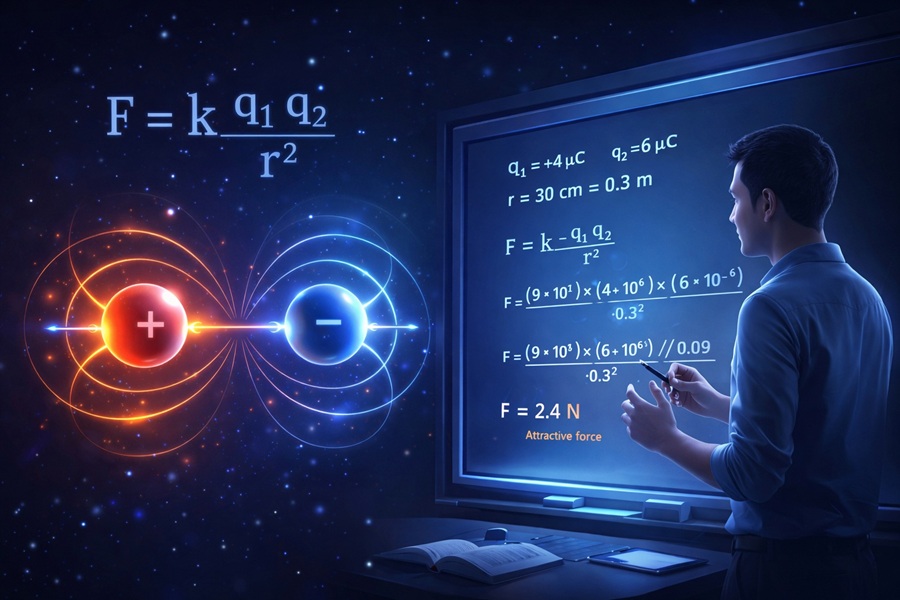
TL;DR: Struggling with Coulomb's law numericals? This post walks you through 8 step-by-step practice problems — from easy two-charge setups to tricky three-charge equilibrium questions — with full answers and common mistake warnings. Whether you're preparing for Class 12 boards, JEE Mains, or NEET, these solved problems will sharpen your concept clarity fast. Bookmark this page and solve every problem before checking the answers.
Most students understand Coulomb's law in theory. Then they see a problem with three charges arranged on a triangle and their mind goes blank.
It's not that the formula is hard. It's F = kq₁q₂/r². That part is simple. The real difficulty kicks in when you need to find the net force, handle unit conversions, or set up a charge equilibrium problem.
In this guide, you'll find Coulomb's law practice problems with answers — solved step by step. I've written each solution the way a good physics teacher would explain it out loud. Every step has a reason. Every answer includes the direction of force, not just the number.
Let's get into it.
What Is Coulomb's Law? (Quick Formula Recap)
Coulomb's law gives the electrostatic force between two point charges. The force is directly proportional to the product of the two charges and inversely proportional to the square of the distance between them. In equation form:
F = k × q₁ × q₂ / r²
Where:
- F = electrostatic force (in Newtons, N)
- k = Coulomb's constant = 9 × 10⁹ N·m²/C²
- q₁, q₂ = magnitudes of the two charges (in Coulombs, C)
- r = distance between the charges (in meters, m)
Two things to always remember. First, like charges repel and unlike charges attract. Second, the unit of distance must always be in metres, not centimetres. Missing that unit conversion is the most common mistake in board exams.
Coulomb's Law Practice Problems: Level 1 (Easy)
Problem 1: Force Between Two Point Charges
Question: Two point charges, q₁ = +4 μC and q₂ = −6 μC, are placed 30 cm apart in vacuum. Find the magnitude and nature of the electrostatic force between them.
Solution:
Step 1 — Convert units.
- q₁ = 4 × 10⁻⁶ C
- q₂ = 6 × 10⁻⁶ C (use magnitude in formula)
- r = 30 cm = 0.30 m
Step 2 — Apply Coulomb's formula.
F = k × q₁ × q₂ / r² F = (9 × 10⁹) × (4 × 10⁻⁶) × (6 × 10⁻⁶) / (0.30)² F = (9 × 10⁹) × (24 × 10⁻¹²) / 0.09 F = 216 × 10⁻³ / 0.09 F = 2.4 N
Nature: Since q₁ is positive and q₂ is negative, the force is attractive.
Problem 2: What Happens When Distance Doubles?
Question: Two charges exert a force of 18 N on each other. If the distance between them is doubled, what is the new force?
Solution:
Coulomb's law tells us F ∝ 1/r². So if r becomes 2r:
F_new = F / (2)² = 18 / 4 = 4.5 N
The force reduces to one-fourth of its original value.
Key takeaway: Force and distance follow an inverse-square relationship. Doubling the distance cuts the force to 25% — not 50%.
Problem 3: Force Between Proton and Electron
Question: Calculate the electrostatic force between a proton and an electron separated by 5 × 10⁻¹¹ m (roughly the Bohr radius of hydrogen).
Given: charge on proton = charge on electron = 1.6 × 10⁻¹⁹ C
Solution:
F = k × q₁ × q₂ / r² F = (9 × 10⁹) × (1.6 × 10⁻¹⁹) × (1.6 × 10⁻¹⁹) / (5 × 10⁻¹¹)² F = (9 × 10⁹) × (2.56 × 10⁻³⁸) / (25 × 10⁻²²) F = (23.04 × 10⁻²⁹) / (25 × 10⁻²²) F = 9.2 × 10⁻⁹ N
Direction: Attractive (opposite charges).
This problem appears often in NEET and Class 12 NCERT exercises. The answer is approximately 9.2 nN toward each other.
Coulomb's Law Practice Problems: Level 2 (Moderate)
Problem 4: Net Force on a Charge Due to Two Others (Collinear)
Question: Three charges are placed on the x-axis. q₁ = +2 μC at x = 0, q₂ = −4 μC at x = 0.3 m, and q₃ = +3 μC at x = 0.6 m. Find the net force on q₂.
Solution:
We need to find two forces and then add them with correct signs.
Force on q₂ due to q₁ (F₂₁): r₁₂ = 0.3 m F₂₁ = (9 × 10⁹) × (2 × 10⁻⁶) × (4 × 10⁻⁶) / (0.3)² F₂₁ = (9 × 10⁹) × (8 × 10⁻¹²) / 0.09 F₂₁ = 72 × 10⁻³ / 0.09 = 0.8 N Direction: q₁ is positive, q₂ is negative → attractive → F₂₁ acts in the –x direction (toward q₁)
Force on q₂ due to q₃ (F₂₃): r₂₃ = 0.3 m F₂₃ = (9 × 10⁹) × (4 × 10⁻⁶) × (3 × 10⁻⁶) / (0.3)² F₂₃ = (9 × 10⁹) × (12 × 10⁻¹²) / 0.09 F₂₃ = 108 × 10⁻³ / 0.09 = 1.2 N Direction: q₃ is positive, q₂ is negative → attractive → F₂₃ acts in the +x direction (toward q₃)
Net force on q₂: F_net = F₂₃ − F₂₁ = 1.2 − 0.8 = 0.4 N in the +x direction
Problem 5: Charges Placed at Corners of a Right Triangle
Question: Three charges are placed at the corners of a right-angled triangle: q₁ = +3 μC at A (origin), q₂ = +3 μC at B (0.04 m, 0), and q₃ = −3 μC at C (0, 0.03 m). Find the net force on q₁.
Solution:
Step 1 — Find all distances.
- r₁₂ = 0.04 m (along x-axis)
- r₁₃ = 0.03 m (along y-axis)
Step 2 — Force on q₁ due to q₂ (F₁₂): F₁₂ = (9 × 10⁹) × (3 × 10⁻⁶) × (3 × 10⁻⁶) / (0.04)² F₁₂ = (9 × 10⁹) × (9 × 10⁻¹²) / 0.0016 F₁₂ = 81 × 10⁻³ / 0.0016 = 50.6 N Direction: Both positive → repulsive → along −x axis
Step 3 — Force on q₁ due to q₃ (F₁₃): F₁₃ = (9 × 10⁹) × (3 × 10⁻⁶) × (3 × 10⁻⁶) / (0.03)² F₁₃ = 81 × 10⁻³ / 0.0009 = 90 N Direction: Opposite charges → attractive → along +y axis
Step 4 — Net force magnitude: F_net = √(F₁₂² + F₁₃²) = √(50.6² + 90²) F_net = √(2560 + 8100) = √10660 ≈ 103.2 N
Direction: θ = tan⁻¹(90 / 50.6) ≈ 60.6° from the −x axis toward +y
What Are the Most Common Mistakes in Coulomb's Law Problems?
Students lose marks not because they don't know the law, but because they make the same careless errors. Here are the three big ones to avoid:
Mistake 1: Not converting centimetres to metres. Always check your distance unit before substituting. r = 20 cm must become r = 0.20 m. If you skip this, your answer will be off by a factor of 10,000.
Mistake 2: Forgetting to square the distance. The formula is 1/r², not 1/r. In a hurry, it's easy to forget the square. This error gives an answer that's wrong by orders of magnitude.
Mistake 3: Adding forces as scalars when they're vectors. When three or more charges are involved, forces have direction. You must resolve each force into x and y components, add them separately, and then find the resultant. Simply adding magnitudes gives a wrong answer.
Coulomb's Law Practice Problems: Level 3 (Hard / JEE-Style)
Problem 6: Equilibrium of Three Charges
Question: Two charges q₁ = +4 μC and q₂ = +9 μC are 20 cm apart. A third charge q₃ is placed between them such that the system is in equilibrium. Find the position and value of q₃.
Solution:
Let q₃ be placed at distance x from q₁ (and 0.20 − x from q₂).
For q₃ to be in equilibrium, the force from q₁ must equal the force from q₂:
k × q₁ × |q₃| / x² = k × q₂ × |q₃| / (0.20 − x)²
4 / x² = 9 / (0.20 − x)²
(0.20 − x)² / x² = 9/4
(0.20 − x) / x = 3/2
0.40 − 2x = 3x → 5x = 0.40 → x = 0.08 m
So q₃ is placed 8 cm from q₁ and 12 cm from q₂.
Sign of q₃: Since both q₁ and q₂ are positive, q₃ must be negative to be attracted toward both. Let's find its value using q₁:
F₁₃ = F₂₃ is already satisfied positionally. For q₁ equilibrium: Force from q₂ on q₁ = Force from q₃ on q₁
k × 4 × 9 / (0.20)² = k × 4 × |q₃| / (0.08)² 9 / 0.04 = |q₃| / 0.0064 |q₃| = 9 × 0.0064 / 0.04 = 1.44 μC
So q₃ = −1.44 μC at 8 cm from q₁.
Problem 7: Coulomb's Law with Dielectric Medium
Question: Two charges exert a force of 40 N on each other in vacuum. A medium of dielectric constant K = 5 is introduced between them. What is the new force?
Solution:
When a dielectric medium is placed between charges, the force becomes:
F_medium = F_vacuum / K = 40 / 5 = 8 N
The medium reduces the force by a factor equal to its dielectric constant. This is an important concept for JEE Mains and NEET — often tested as a single-line problem.
Problem 8: Gravitational vs. Electrostatic Force Comparison
Question: Compare the electrostatic force and gravitational force between two protons placed 1 × 10⁻¹⁵ m apart (nuclear distance).
Given:
- Charge of proton, e = 1.6 × 10⁻¹⁹ C
- Mass of proton, m = 1.67 × 10⁻²⁷ kg
- G = 6.67 × 10⁻¹¹ N·m²/kg²
- k = 9 × 10⁹ N·m²/C²
Solution:
Electrostatic force: Fₑ = k × e² / r² Fₑ = (9 × 10⁹) × (1.6 × 10⁻¹⁹)² / (10⁻¹⁵)² Fₑ = (9 × 10⁹) × (2.56 × 10⁻³⁸) / (10⁻³⁰) Fₑ = 230.4 N
Gravitational force: Fg = G × m² / r² Fg = (6.67 × 10⁻¹¹) × (1.67 × 10⁻²⁷)² / (10⁻¹⁵)² Fg = (6.67 × 10⁻¹¹) × (2.79 × 10⁻⁵⁴) / (10⁻³⁰) Fg = 1.86 × 10⁻³⁴ N
Ratio: Fₑ / Fg = 230.4 / (1.86 × 10⁻³⁴) ≈ 1.2 × 10³⁶
The electrostatic force is about 10³⁶ times stronger than gravity at the nuclear scale. This comparison is a classic NCERT question and a favourite in board exams.
Conclusion
Coulomb's law problems feel hard until you see the pattern. Every problem, at its core, uses the same formula: F = kq₁q₂/r². What changes is how many charges are involved and what you're solving for.
Here are the three things to take away from this post:
- Always convert centimetres to metres before plugging in values.
- Use superposition — solve each pair of charges separately, then add forces as vectors.
- For equilibrium problems, set forces equal and solve for position first, then find the charge.
Want more problems like these? Explore the rest of physicsfiction.org for concept-first explanations of Class 12 Physics, JEE topics, and real-world physics applications — explained without the jargon.
If you found this post useful, share it with a friend who's preparing for boards or competitive exams. It might be the push they need.
Frequently Asked Questions
Q1. What is Coulomb's law in simple words? Coulomb's law says that the force between two charged objects depends on how big the charges are and how far apart they sit. Bigger charges mean bigger force. More distance means smaller force. Specifically, the force drops with the square of the distance — so doubling the distance cuts the force to one-fourth.
Q2. What is the value of Coulomb's constant k? The value of Coulomb's constant is k = 9 × 10⁹ N·m²/C². It can also be written as 1 / (4πε₀), where ε₀ (epsilon-naught) is the permittivity of free space and equals 8.85 × 10⁻¹² C²/N·m².
Q3. How do you find the net force when three charges are involved? Use the superposition principle. Calculate the force between each pair of charges separately using F = kq₁q₂/r². Then resolve each force into x and y components. Add all x-components and all y-components separately. Finally, use F_net = √(Fₓ² + Fᵧ²) to find the resultant magnitude.
Q4. Does Coulomb's law work in a medium other than vacuum? Yes, but the force changes. In a medium with dielectric constant K, the force becomes F_medium = F_vacuum / K. So if K = 5, the force in that medium is one-fifth of what it would be in vacuum. This is a common concept in JEE and NEET problems.
Q5. What is the difference between Coulomb's law and Newton's law of gravitation? Both follow the inverse-square law and act along the line joining two objects. But gravity is always attractive and acts on mass, while the electrostatic force can be attractive or repulsive and acts on charge. At atomic distances, the electrostatic force is roughly 10³⁶ times stronger than gravitational force.