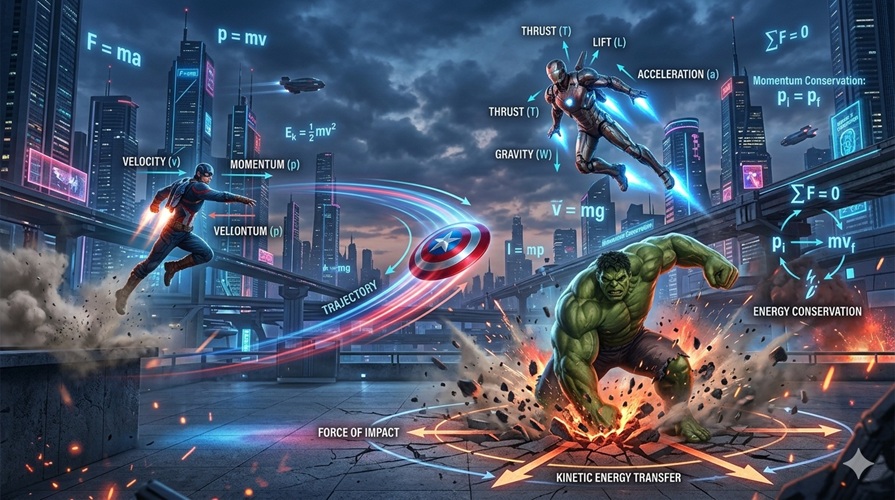
Have you ever watched an Avengers fight scene and wondered, “Could this actually happen in real life?”
That question is exactly why the depiction of physics in Avengers movies is so fascinating.
From Avengers: Endgame time travel to Iron Man’s flying suit and Hulk’s incredible strength, Marvel often mixes real scientific ideas with bold imagination. The problem is that many scenes feel believable, which makes it hard to tell what follows real physics and what breaks every known law of nature.
In this blog, we’ll break it down in simple words so you can clearly see what Marvel gets right, what it exaggerates, and what students can actually learn from it.
Marvel movies feel realistic because they borrow ideas from actual science.
Even when the powers are fictional, the action scenes often use concepts like:
These are real physics principles.
For example, when Captain America throws his shield, the movie uses believable bouncing angles and impact forces. This makes the scene feel grounded, even if the shield’s material is fictional.
That mix of truth and imagination keeps viewers engaged.
Some physics ideas in Avengers are actually close to real science.
When Captain America throws his shield, it follows the physics of projectile motion.
A moving object follows a path based on:
The bouncing scenes are exaggerated, but the basic idea of changing direction after impact is real.
This is a fun way to understand:
When Hulk punches something, Marvel often shows the target flying away.
This follows Newton’s Second Law:
F=ma
The bigger the force, the greater the acceleration.
So yes, a stronger punch means greater impact.
A real human body would not survive producing or absorbing that much force.
Bones, muscles, and joints all have limits.
So the physics law is right, but Hulk’s biology is pure fiction.
Iron Man’s suit is one of the coolest examples of movie science.
Some parts are realistic:
These already exist in basic forms today.
The real issue is the arc reactor.
To power:
…the suit would need an unbelievable amount of energy in a tiny device.
This is a great way to teach:
Ant-Man is one of the most fun but least accurate physics concepts.
The movie says he shrinks by reducing the space between atoms.
Sounds scientific—but it creates a huge problem.
Sometimes Ant-Man becomes tiny but still hits with full force.
That breaks the relationship between:
If mass stayed the same, he would still weigh the same.
If mass reduced too, his punches would become weak.
Marvel changes this rule depending on the scene.
👉 Great storytelling, weak physics.
The time travel in Avengers: Endgame is based on the Quantum Realm.
This mixes:
Real physics does discuss:
But the movie’s exact method is fictional.
Traveling to the future through relativity is scientifically possible in theory.
Jumping into the past and changing events is still speculative.
Some parts might.
This is where superhero movies become useful.
Marvel scenes can help students understand:
Movies make abstract ideas easier to imagine.
For example:
👉 Hulk = force
👉 Iron Man = thrust
👉 Captain America = projectile motion
👉 Ant-Man = density and mass questions
This is why physics becomes more fun when connected to stories.
Some concepts use real physics ideas, but powers are mostly fictional.
A simplified exoskeleton version is possible, but the energy source is unrealistic.
Not with current understanding of atomic structure and mass.
Future time travel is theoretical. Past time travel remains fictional.
The depiction of physics in Avengers movies is a clever mix of real science and cinematic imagination.
Marvel often starts with real principles like force, momentum, and energy, then stretches them far beyond reality for entertainment.
That’s exactly why these movies are so powerful for learning.
They help students and curious readers connect physics concepts to scenes they already love.
And once science becomes visual, it becomes easier to remember.