How Does a Solar Panel Utilize the Photoelectric Effect?
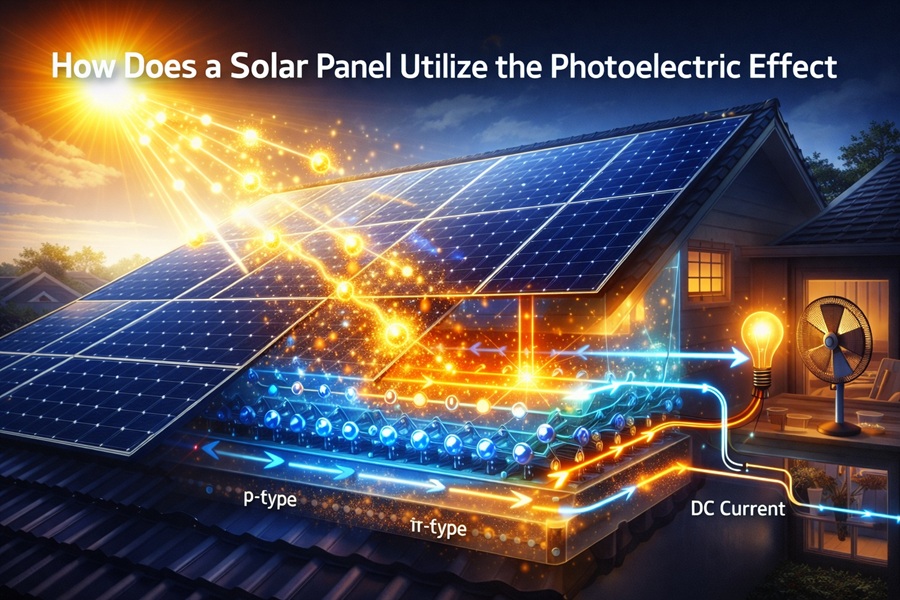
Your phone charger, calculator, and rooftop solar panels all depend on one brilliant idea from quantum physics.
It’s easy to look at a solar panel and think it simply “collects sunlight.” But what really happens inside is far more fascinating. Tiny particles of light hit a special material, energize electrons, and create a flow of electricity that can power your fan, lights, or even your entire home.
That process is based on the photoelectric effect, one of the most important discoveries in modern physics. In simple words, when light with enough energy strikes a material, it can transfer energy to electrons and make them move. Solar panels use this principle in a highly practical way through the photovoltaic effect, turning sunlight directly into usable electricity.
Think about a rooftop solar panel running a fan on a hot summer afternoon. The sunlight falling on the panel is quietly triggering billions of tiny electron movements every second. Those invisible movements become the electricity you use in daily life.
Let’s break this down in the simplest way possible.
What Is the Photoelectric Effect in Simple Words?
The photoelectric effect is the process where electrons gain energy when light hits a material.
Imagine electrons as people sitting calmly in a movie theater. When photons from sunlight arrive, it’s like the lights suddenly turn on and everyone gets up at once. The electrons “jump” because they receive energy from the light.
The important thing to understand is that light carries energy in tiny packets called photons. Each photon has a certain amount of energy. If that energy is high enough, it can free or excite an electron.
E = hf
This famous relation, explained by Albert Einstein, shows why frequency matters more than brightness. A brighter light gives more photons, but if each photon does not have enough energy, electrons still won’t move effectively.
Real-Life Example to Understand It
A simple example is a solar garden light.
During the day, sunlight hits the small solar cell on top. The photons energize electrons in the semiconductor, producing current that charges the battery. At night, the stored energy powers the LED.
This is the photoelectric idea working in your garden every day.
What Is a Solar Panel Made Of?
A solar panel is made up of many small solar cells, and each cell is usually made from silicon, the most common semiconductor used in solar technology.
Solar Cells and Semiconductor Layers
Inside each solar cell are two specially treated silicon layers:
-
p-type layer with positive holes
-
n-type layer with extra electrons
Where these two layers meet, they form a p-n junction.
This junction is extremely important because it creates an internal electric field that directs the flow of charges.
Why Silicon Is Used in Solar Panels
Silicon is popular because it checks all the right boxes.
It is abundant in nature, allows electrons to move efficiently, and absorbs sunlight very well. It also remains stable for many years, which is why rooftop panels can last decades.
That’s why silicon remains the heart of most solar power systems.
How Solar Panels Use the Photoelectric Effect Step by Step
Now let’s see how sunlight becomes electricity in a real solar panel.
Step 1 – Sunlight Photons Strike the Solar Cell
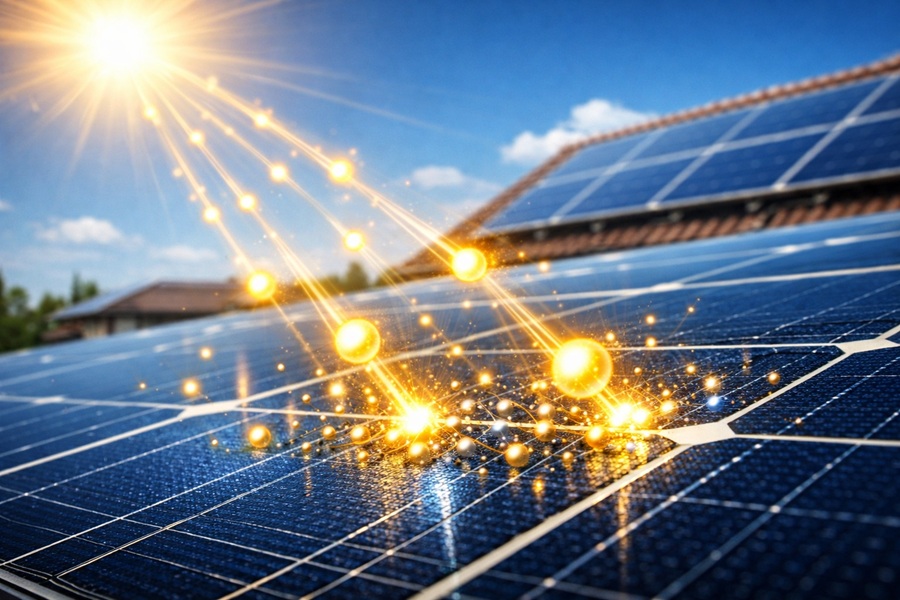
When sunlight falls on the panel, billions of photons strike the silicon surface.
Each photon carries energy. Some have enough energy to interact strongly with the silicon electrons.
Step 2 – Electrons Absorb Photon Energy
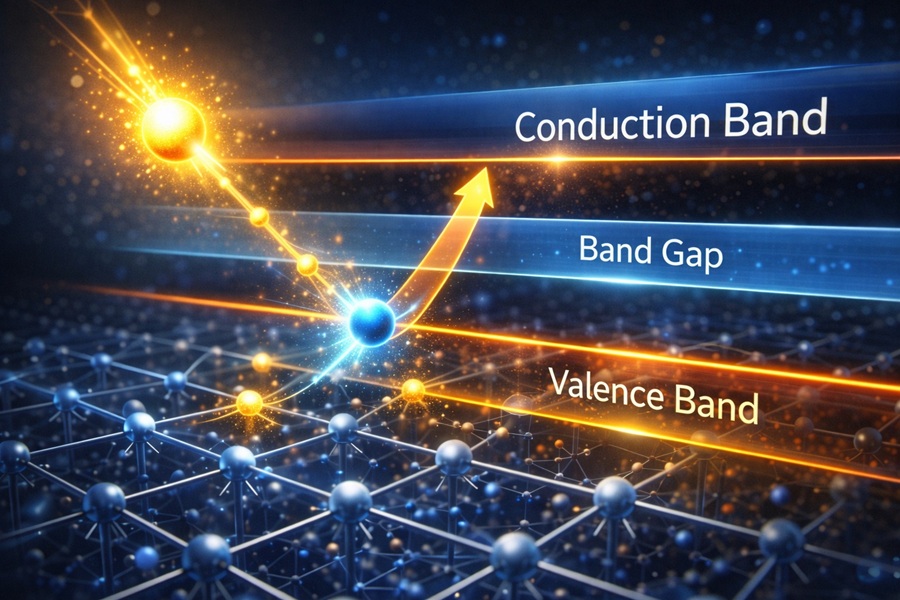
When a photon transfers its energy to an electron, that electron becomes excited and jumps into a higher energy state.
E_{photon} \geq E_g
This means the photon’s energy must be at least equal to the semiconductor’s band gap energy.
Once this happens, the electron moves into the conduction band, where it is free to move through the material.
Step 3 – Electron-Hole Pairs Are Created
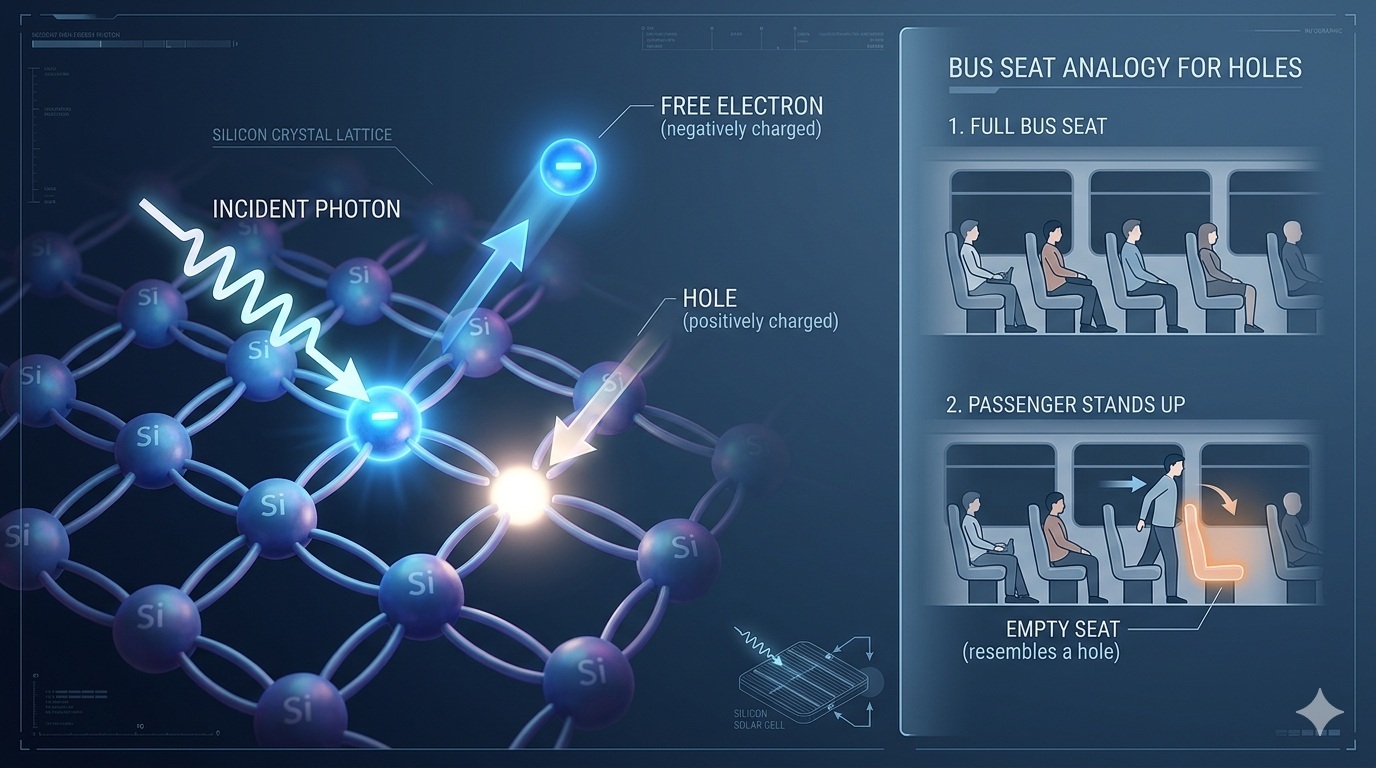
As soon as the electron moves, it leaves behind an empty space called a hole.
The easiest way to imagine this is a bus seat.
If one passenger gets up, an empty seat is left behind. Another passenger can move into that seat, and the empty spot seems to “move” backward.
That moving empty seat behaves like a positive charge, which we call a hole.
So now the solar cell has:
-
a free electron
-
a positive hole
This pair is the foundation of solar current generation.
Step 4 – Internal Electric Field Pushes Charges
The p-n junction creates a built-in electric field.
This field pushes electrons toward one side and holes toward the other side. Because charges are separated in opposite directions, a voltage difference develops across the cell.
This separation is what makes electricity generation possible.
Step 5 – Electric Current Flows Through Wires
When the solar cell is connected to a wire, free electrons flow through the external circuit.
That moving flow of electrons is electric current.
The electricity produced is DC current, which can directly charge batteries or be converted into AC using an inverter for home appliances.
So when your fan runs from a rooftop panel, it’s really powered by countless energized electrons moving through wires.
Photoelectric Effect vs Photovoltaic Effect
This is where many students get confused.
Are They the Same?
They are closely related, but there is a small difference.
In the photoelectric effect, electrons may completely leave the surface of a material.
In the photovoltaic effect, electrons remain inside the semiconductor and are guided in a way that creates usable current.
So the idea is similar, but the outcome is different.
Why Solar Panels Use the Photovoltaic Version
Solar panels use the photovoltaic version because it is much more practical for generating electricity.
Instead of losing electrons from the material, the semiconductor keeps them inside and directs them through a circuit, making continuous power generation possible.
That’s why solar cells are designed around semiconductors and p-n junctions.
Daily Life Examples of Solar Panels Using This Effect
This concept is all around you, even if you don’t notice it.
Rooftop Home Solar Systems
These systems convert sunlight into electricity for homes, reducing dependence on the grid.
Solar Street Lights
They collect sunlight during the day and power roads at night.
Solar Calculators
The tiny dark strip on the calculator display is a photovoltaic cell.
Satellites and Spacecraft
Most satellites depend on solar panels because sunlight is abundant in space.
Solar Power Banks
Portable solar chargers use the same principle to recharge phones and small devices.
Factors That Affect How Efficient the Photoelectric Effect Works
Not every photon becomes electricity. Several real-world factors affect efficiency.
Light Intensity
More sunlight means more photons hitting the panel, increasing current output.
Photon Frequency
Higher frequency photons carry more energy, making electron excitation easier.
Panel Temperature
Interestingly, too much heat can reduce solar efficiency.
Angle of Sunlight
Panels work best when sunlight strikes them directly.
Dust and Shadow Losses
Dust, leaves, or partial shade reduce the number of photons reaching the silicon.
Why This Concept Matters in Modern Renewable Energy
This simple physics principle is helping reshape the future.
Clean Electricity Generation
Solar panels generate power without burning fuel or producing pollution.
Reduced Electricity Bills
Homes with rooftop systems can significantly lower monthly costs.
Sustainable Future
Sunlight is renewable, making solar one of the best long-term energy solutions.
Role in Space Technology
From satellites to deep-space probes, solar cells are essential for modern space missions.
Common Misconceptions Students Have
“Solar Panels Store Sunlight”
They don’t.
Solar panels generate electricity, while batteries store the generated energy.
“Heat Produces the Electricity”
This is a common myth.
It is light photons, not heat, that energize electrons.
“Brighter Means Always Better”
Not necessarily.
Photon frequency and semiconductor band gap are just as important as brightness.
People Also Ask (PAA)
How does the photoelectric effect generate electricity in solar panels?
Photons transfer energy to electrons in silicon, allowing them to move through a circuit as electric current.
Is the photovoltaic effect the same as the photoelectric effect?
They are related, but photovoltaic effect specifically refers to current generation inside semiconductors.
Why is silicon used in solar cells?
Silicon is stable, widely available, and excellent at absorbing sunlight.
Do solar panels work without direct sunlight?
Yes, they still work in cloudy weather using diffused sunlight, though less efficiently.
What happens to electrons inside a solar panel?
They gain energy, move into the conduction band, and flow through an external circuit.
Why do solar panels produce DC current first?
Because electrons naturally flow in one direction through the solar cell structure.
Who discovered the photoelectric effect used in solar panels?
Albert Einstein gave the theoretical explanation that made this concept famous.
Conclusion
So, how does a solar panel utilize the photoelectric effect?
It starts when sunlight photons hit silicon and transfer energy to electrons. Those electrons move, create electron-hole pairs, and the p-n junction directs them into a current that powers real devices.
What looks like a simple black panel on a rooftop is actually a powerful real-life application of quantum physics.
Every time sunlight hits a rooftop panel, quantum physics quietly powers your home.