Potential energy examples in daily life at home are all around us, even in the most common objects we use every day. From a book resting on a shelf to water stored in an overhead tank, many household items store energy because of their position, shape, or condition. This stored energy is called potential energy, and understanding it becomes much easier when we connect physics with real life.
In this article, you will discover 15 easy home-based examples of potential energy, explained in simple language with relatable objects. If you are a student, parent, or physics lover, these examples will help you understand the concept quickly.
Potential energy is the stored energy an object has because of its position, shape, or state.
The most common formula is:
PE = mgh
Where:
A simple home example is a flower pot kept on a balcony railing. Because it is at a height, it stores energy. If it falls, that stored energy changes into motion.
Think of it like money saved in a wallet. The money is not being used yet, but it has the potential to do work later.
Our homes are full of objects that naturally store energy.
This happens because of:
Physics becomes easy when you start noticing these examples around you.
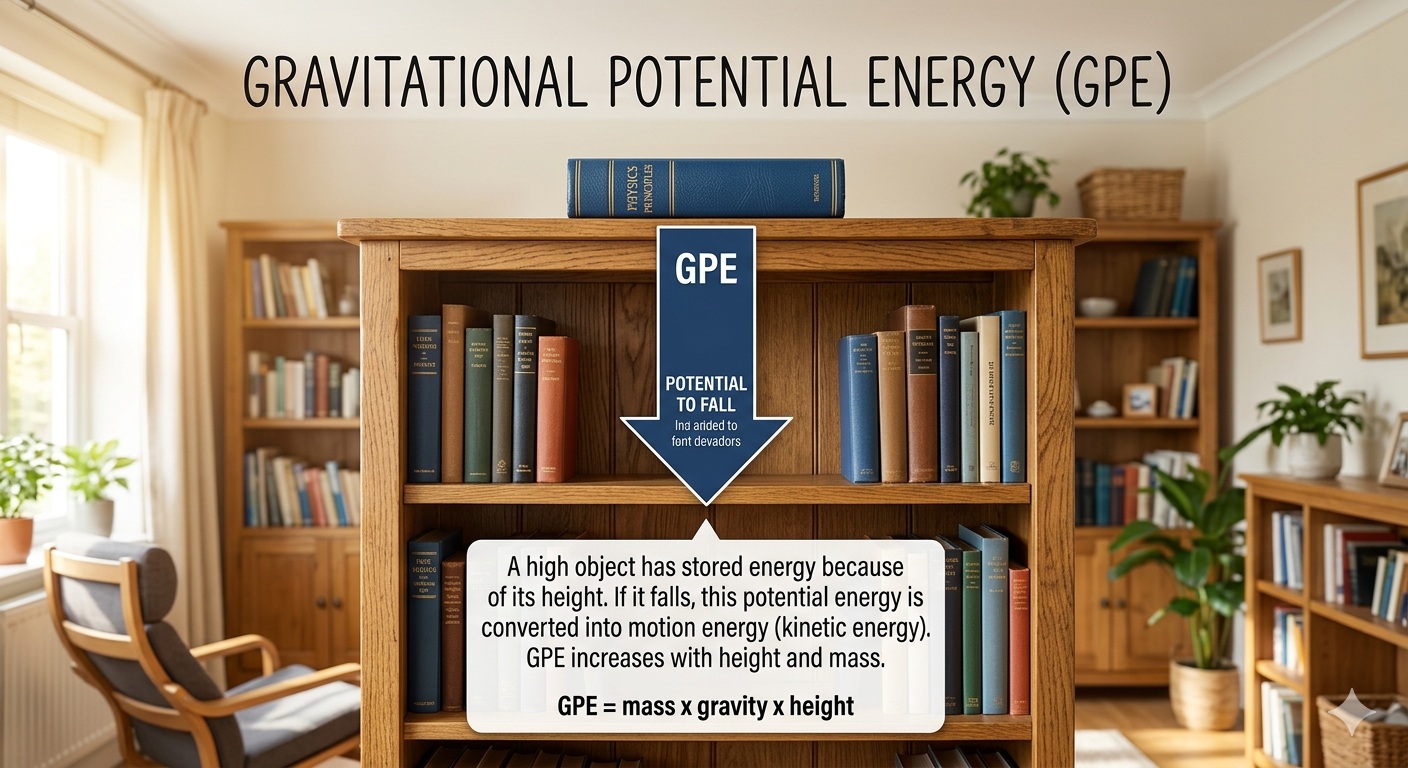
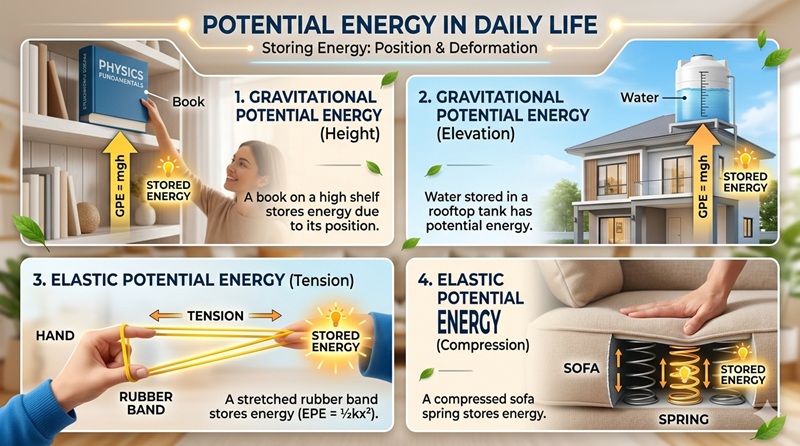
A book placed on a high shelf has gravitational potential energy because of its height.
The higher the shelf, the more stored energy it has.
If the book falls, the energy changes into kinetic energy.
This is one of the best potential energy examples in daily life at home.
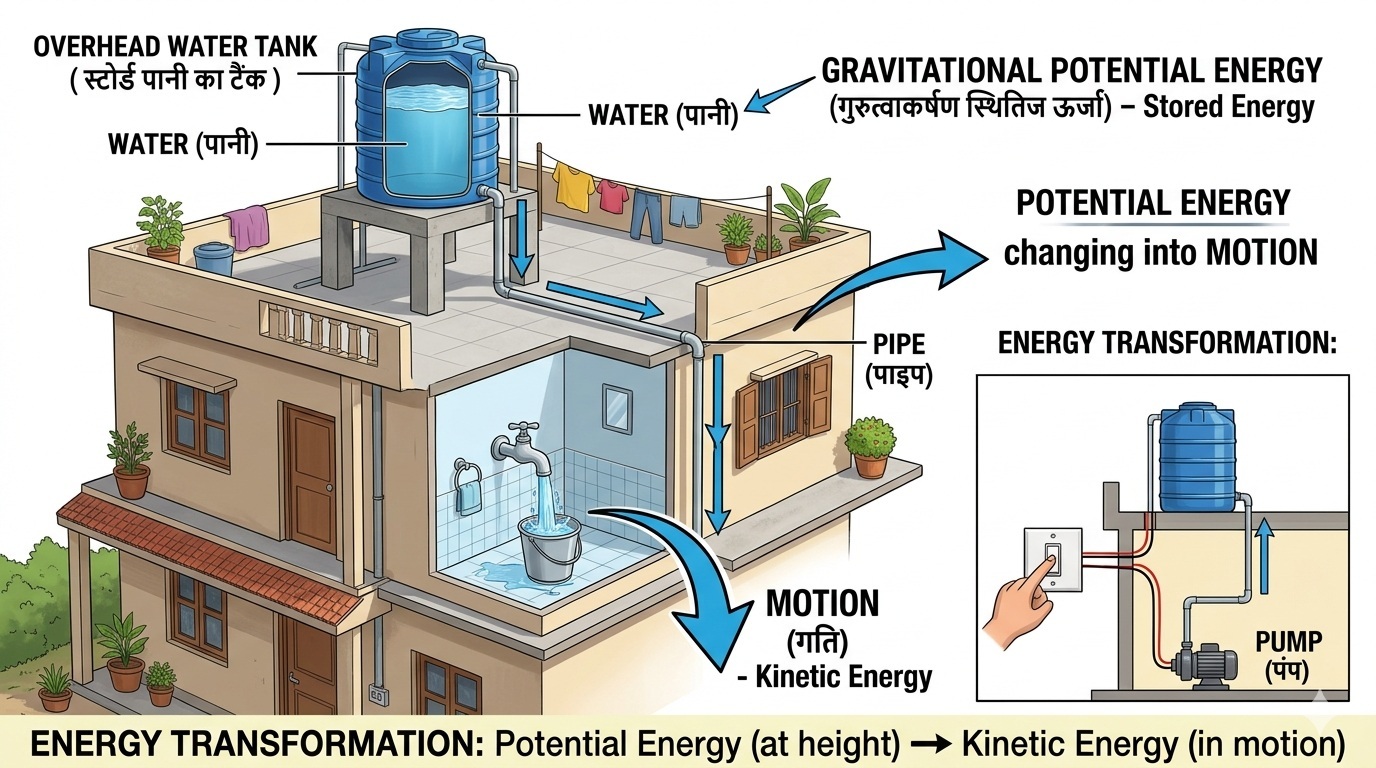
Water stored in an overhead tank has energy because it is kept at a height. When you open the tap, gravity pulls it downward and the stored energy turns into flowing motion.
This is why water flows naturally without a motor every time.
When you stretch a rubber band, it stores elastic potential energy.
Once released, it quickly snaps back and the stored energy becomes motion.
This is one of the easiest examples students can try at home.
When you sit on a sofa, the spring inside gets compressed.
The compressed spring stores energy. When you stand up, it returns to its original shape and releases that energy.
Your sofa is silently teaching physics every day.
Imagine lifting a bucket full of water.
As you raise it higher, it gains more gravitational potential energy.
Once released, it falls due to gravity.
Window blinds pulled upward store energy because they are held at a higher position.
When released, they roll down and the stored energy converts into movement.
This is a perfect home example of height-based stored energy.
Many doors have automatic closing springs.
When you open the door, the spring stretches or twists and stores energy.
After release, the spring uses that stored energy to close the door.
A spring toy gun is a fun physics example.
When the spring is pressed, it stores elastic potential energy.
As soon as the trigger is pressed, the spring pushes the dart forward.
Kids enjoy this example because it is easy to visualize.
A charged inverter battery stores chemical potential energy.
When electricity goes off, the battery converts stored chemical energy into electrical energy.
This is a modern household example of potential energy.
A pendulum lifted to one side stores gravitational potential energy.
As it swings down, the stored energy becomes kinetic energy.
This cycle keeps repeating in pendulum clocks.
A cooking gas cylinder stores energy in the compressed gas.
This stored pressure energy is another form of potential energy.
When the gas is released into the stove, it can produce heat energy.
When you press a sponge, it gets compressed and stores elastic potential energy.
As soon as you release it, it returns to shape.
A simple bathroom object can explain a physics law beautifully.
A toy bow stores energy when the string is pulled backward.
The stretched string stores elastic potential energy.
On release, the arrow moves forward rapidly.
Some modern kitchen drawers use spring systems.
When pulled or pushed, the spring mechanism stores energy and helps the drawer move smoothly.
This is another invisible example of potential energy at home.
Before the whistle releases steam, pressure builds inside the cooker.
This stored pressure is a type of potential energy.
When the whistle lifts, the pressure energy is released as sound and steam motion.
This is where physics becomes exciting.
Potential energy turns into kinetic energy when the stored energy is released.
Examples:
So the motion you see is simply stored energy becoming moving energy.
|
Type |
Home Example |
|
Gravitational Potential Energy |
Book on shelf, water tank |
|
Elastic Potential Energy |
Rubber band, sofa spring |
|
Chemical Potential Energy |
Inverter battery |
|
Pressure Potential Energy |
Gas cylinder, cooker whistle |
This comparison helps students remember the concept faster.
Now you can easily spot potential energy examples in daily life at home all around you.
From your sofa spring to your water tank, physics is working silently in everyday objects. The best way to learn science is to connect it with real life.
At Physics Fiction, we make physics easy using home objects, daily examples, and simple imagination so students can truly understand the concept instead of memorizing it.
If you observe carefully today, your entire home can become a small physics laboratory.
Common examples include a book on a shelf, water tank, rubber band, spring mattress, and gas cylinder.
Yes. Because it is stored at a height, it has gravitational potential energy.
Yes. It stores elastic potential energy.
A book on a shelf is the easiest example because it clearly shows stored energy due to height.
When the object is released, the stored energy changes into kinetic energy.