The Real Physics of Oppenheimer: What the Movie Got Right
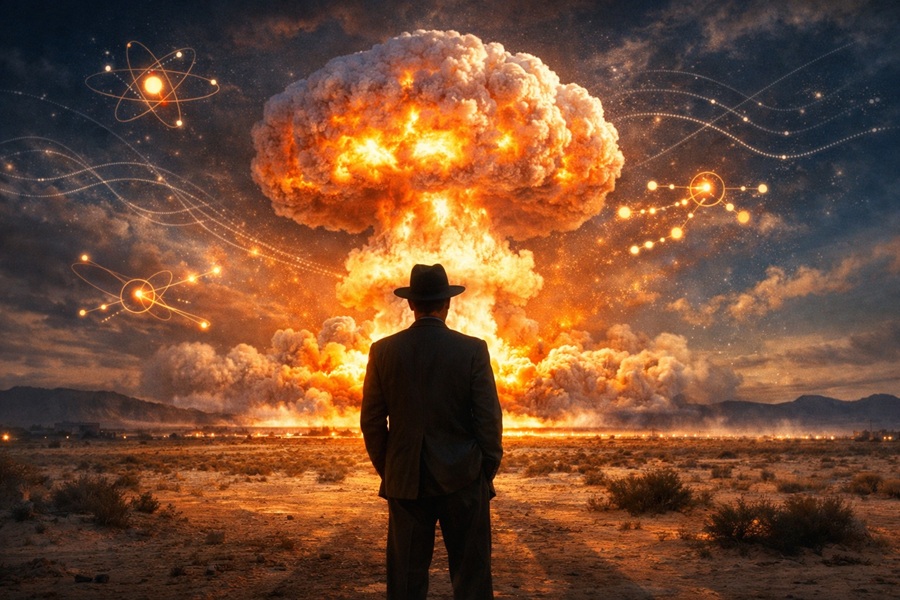
Christopher Nolan's Oppenheimer is one of the most scientifically honest films ever made. From the Trinity Test shockwave to the quantum debates between Bohr and Oppenheimer, the physics holds up remarkably well. This post breaks down the key science behind the film — scene by scene, concept by concept — so you understand both the movie and the real physics that changed the world forever.
It's 5:29 AM on July 16, 1945. The New Mexico desert is completely silent.
Then, a flash brighter than the sun. A shockwave that knocks men off their feet miles away. A fireball that rises 40,000 feet into the sky.
The Trinity Test had just worked.
If you've watched Oppenheimer and asked yourself, "Did Nolan actually get the physics right?" — you're asking exactly the right question. The oppenheimer movie physics explained debate has been raging since the film released. Scientists, students, and curious viewers all want to know: how much of what they saw was real?
The short answer: more than you'd expect from Hollywood.
This post walks you through the core science behind the film. No heavy textbooks. No impossible jargon. Just the real physics, explained clearly, starting from the atom and ending with the explosion that changed everything.
What Was the Manhattan Project Actually Trying to Build?
The Manhattan Project was a top-secret programme to build a nuclear weapon by splitting uranium or plutonium atoms — releasing enormous energy through a process called nuclear fission. Scientists needed just enough of the right material in the right shape to trigger a self-sustaining chain reaction. That threshold is called "critical mass," and finding it was the entire scientific challenge.
Think of it this way. Imagine a single spark landing on one dry leaf. Nothing happens. But throw that same spark into a pile of dry leaves, and the fire spreads from leaf to leaf. In nuclear fission, neutrons are the sparks and uranium-235 atoms are the leaves. One atom splits, releases neutrons, those neutrons hit more atoms, which split and release more neutrons — and in millionths of a second, you have an explosion.
The film shows two bomb designs running simultaneously. That part is historically accurate. The "Little Boy" design used a gun-type mechanism: a slug of uranium fired down a barrel into another uranium target. The "Fat Man" design used implosion: conventional explosives arranged in a sphere to compress a plutonium core inward from all sides. Both designs needed to reach critical mass in different ways. The Atomic Heritage Foundation documents both designs in extensive detail for anyone who wants to go deeper.
The film's lab sequences, the chalkboard calculations, the frantic energy of Los Alamos — all of it reflects the real pressure these scientists were under to solve a physics problem that had never been solved before.
Does the Trinity Test Scene in the Film Actually Look Right?
Yes — Nolan's Trinity Test sequence is one of the most physically accurate nuclear depictions ever put on screen. The key sequence — silence, blinding flash, then a delayed shockwave that physically hits the observers — follows the documented physics of the 1945 test almost exactly. Light travels at 300,000 kilometres per second. Sound travels at roughly 343 metres per second. When you're standing 10 kilometres away, you see the flash instantly. The sound and shockwave arrive seconds later.
That delay is not a cinematic choice. It is physics.
Nolan famously shot the explosion practically, using miniatures and real chemical reactions rather than CGI. This actually helped him get the physics right. Declassified Trinity Test footage shows the exact same sequence: white flash, expanding fireball, the Mach stem shockwave rolling across the desert floor.
The film also nails the colour progression of the blast. The initial fireball is blue-white (extreme heat, ultraviolet radiation dominant). As it expands and cools, it shifts toward orange and red. Declassified photographs from 1945 confirm this temperature-colour relationship matches real blackbody radiation physics.
What Nolan leaves out — wisely, for a film — is the gamma radiation burst, the neutron flux, and the electromagnetic pulse that would have fried electronics across a wide radius. Some creative choices are just good storytelling.
What Is Quantum Mechanics and Why Did It Define Oppenheimer's Career?
Quantum mechanics is the branch of physics that explains how the universe behaves at the scale of atoms and subatomic particles — and at that scale, the rules of everyday physics completely break down. Particles don't have fixed positions until you measure them. Energy comes in discrete packets called quanta. And nothing is certain; only probabilities exist.
J. Robert Oppenheimer wasn't just a bomb-builder. He was a world-class quantum physicist who studied under Niels Bohr in Copenhagen and trained in Göttingen, Germany, which was the global centre of quantum theory in the late 1920s. He understood the field at the deepest level.
When I studied quantum mechanics during my M.Sc. in Physics, the uncertainty principle felt abstract and almost frustrating. Watching Oppenheimer made me realise that Nolan captured something most science films miss: for these scientists, quantum mechanics wasn't just a theory. It was a lens through which they saw everything — including the bomb.
The film opens with a stunning visual metaphor: Oppenheimer staring at rippling patterns of light and energy. This is a direct reference to how quantum physicists think. Reality at the quantum level looks nothing like the solid, predictable world we experience. Werner Heisenberg's Uncertainty Principle states that you can never know both the position and momentum of a particle with perfect precision at the same time. The more precisely you know one, the less you can know the other.
The debates between Bohr and Oppenheimer in the film are real. They were genuinely wrestling with the meaning of quantum theory. What does it mean for something to exist only as a probability? These weren't abstract questions — they shaped how Oppenheimer understood the weapon he was building.
If you want to explore how quantum behaviour shows up in the real world, the concepts that confused Oppenheimer's generation are now taught in school curricula. The ideas feel less alien once you see how they connect to everyday phenomena.
The Physics of the Bomb: Fission, Chain Reactions, and E = mc²
This is where Einstein's famous equation becomes devastatingly practical.
E = mc² means that mass and energy are the same thing in different forms. A tiny amount of mass can become an enormous amount of energy, because c (the speed of light, 300,000,000 metres per second) is an enormous number, and you're squaring it.
In a nuclear fission reaction, when a uranium-235 nucleus splits, the total mass of the products is very slightly less than the original mass. That missing mass converts directly into energy. We're talking about a mass difference of less than 0.1% — and yet one kilogram of fissile material, if fully consumed, releases energy equivalent to roughly 85 terajoules. The Hiroshima bomb used just 64 kilograms of uranium, of which less than a kilogram actually underwent fission.
The implosion design shown in the film is particularly clever physics. Conventional explosives arranged as "lenses" around a plutonium sphere detonate simultaneously from all sides. The shockwaves compress the core inward, increasing its density until it reaches supercriticality. The plutonium goes from subcritical to critical to supercritical in microseconds.
Los Alamos National Laboratory's public history confirms that the implosion lens design was one of the hardest engineering challenges of the project. Getting all those conventional explosives to detonate within microseconds of each other required a level of precision that didn't really exist before the Manhattan Project.
The film's blackboard scenes, the calculation montages, the arguments about initiators and plutonium impurities — this is real. These were genuine unsolved problems that some of the world's best physicists worked on under pressure.
Did Scientists Really Fear the Bomb Could Ignite the Atmosphere?
Yes — and this is one of the most underrated true stories in the history of science. Before the Trinity Test, some scientists genuinely worried that detonating a nuclear weapon might ignite nitrogen in the atmosphere, triggering a chain reaction that could destroy all life on Earth. The concern was real enough to require a formal scientific calculation.
In 1942, physicist Hans Bethe, along with Emil Konopinski and Edward Teller, carried out a rigorous analysis of whether a nuclear detonation could propagate through atmospheric nitrogen. Their report concluded that the energy required to sustain such a reaction was far higher than any fission bomb could produce. The nitrogen ignition threshold simply couldn't be reached. The probability was not small — it was effectively zero by the physics.
The film references this moment. It's portrayed as a flicker of existential fear rather than a full dramatic subplot. That's actually the right call. The scientists calculated their way out of the fear. They didn't ignore it; they solved it. That's science working exactly as it should.
What makes this story remarkable is that a group of people were about to set off the largest artificial explosion in human history, and they first stopped to rigorously calculate whether it might end the world. And when the math said it wouldn't, they proceeded.
That is a profound act of trust in physics.
What Did Oppenheimer Mean by "I Am Become Death"?
After the Trinity Test, Oppenheimer recalled a line from the ancient Hindu text the Bhagavad Gita: "Now I am become Death, the destroyer of worlds." He recounted this memory years later in a television interview.
It's a line that lives at the intersection of physics and philosophy.
To understand why it hits so hard, you need to feel the energy scales involved. A single uranium atom is invisible to the naked eye. Its nucleus is a hundred thousand times smaller than the atom itself. And yet the energy locked inside the nucleus of that one atom, when released, is millions of times greater than the energy holding the atom's electrons in place.
Scale that up to kilograms of material and you move from invisible to civilisation-ending. The energy released at Hiroshima was equivalent to roughly 15,000 tonnes of TNT — from a device that could fit in the back of a truck. That jump in scale is what the film tries to show, and largely succeeds.
The "Destroyer of Worlds" moment in the film is one of the most honest representations of what it must feel like to understand the physics completely and still pull the trigger. Oppenheimer didn't just build a weapon. He built a weapon while understanding, in precise mathematical detail, exactly what it would do.
For students exploring the physics of energy and forces — from kinetic energy in everyday objects to nuclear scales — this is where the abstract becomes real. Energy is the thread connecting everything from a bouncing ball to an atomic bomb.
How Accurate Is the Oppenheimer Movie Overall? A Physicist's Verdict
Oppenheimer is one of the most scientifically accurate mainstream films ever made about physics, achieving a rare balance between dramatic storytelling and genuine technical honesty. The core physics — fission chain reactions, the Trinity Test sequence, quantum mechanics debates, atmospheric ignition fears, and E = mc² — are all represented faithfully. Where the film simplifies, it does so without creating misconceptions.
Here's an honest scorecard:
What the film gets exactly right: the visual sequence of the Trinity Test (flash before shockwave), the two competing bomb designs, the Bethe atmospheric ignition calculation, the Copenhagen Interpretation debates, and the frantic engineering problems at Los Alamos.
What it simplifies for drama: the internal structure of the implosion device, the full mathematical complexity of critical mass calculations, and the specific role of the "initiator" that started the chain reaction.
The one notable creative choice: the film never fully shows the human consequences of Hiroshima and Nagasaki. This is a directorial decision Nolan has spoken about. It keeps the focus on Oppenheimer's perspective, but it also means the physics of destruction is portrayed without the human scale of what that destruction actually meant.
Overall: Nolan consulted Kai Bird and Martin Sherwin's biography American Prometheus, which is the definitive historical source. He brought real physicists into the production process. The result is a film that treats its audience as intelligent enough to handle real science.
That respect for the audience is what makes Oppenheimer extraordinary — and rare.
Conclusion
Three things are worth taking away from this.
First: the physics in Oppenheimer is not decoration. It's the point. Every quantum debate, every chain-reaction diagram, every anxious calculation was real science done by real people under unimaginable pressure.
Second: understanding the physics makes the drama hit harder. When you know what a chain reaction actually is, the moment Oppenheimer waits for the Trinity blast isn't just suspense. It's the result of a decade of the world's most brilliant minds working on a single problem.
Third: this is why physics matters beyond the classroom. The science Oppenheimer and his colleagues developed in the 1940s still shapes nuclear energy, medical imaging, and global security policy today.
If this post sparked your curiosity, don't stop here. Explore more physics explained through real stories and real science at physicsfiction.org. Whether you're studying for JEE, NEET, or just chasing that feeling of understanding something deeply — the physics that built the atomic age is a great place to start.
The desert went silent before the blast. The physics was always there. Now you can hear it.
Frequently Asked Questions
Did the Oppenheimer movie accurately depict the Trinity nuclear test?
Yes, to a high degree. The sequence of events in the film — bright flash followed seconds later by a shockwave — matches the documented physics and declassified footage of the 1945 Trinity Test. Light travels almost instantaneously, while the shockwave moves at the speed of sound, arriving seconds later to observers miles away. Nolan shot the explosion practically rather than with CGI, which helped preserve physical accuracy in the visual details.
What is critical mass and how was it relevant to the Manhattan Project?
Critical mass is the minimum amount of fissile material needed to sustain a nuclear chain reaction. Below critical mass, too many neutrons escape without hitting other atoms, and the reaction fizzles out. Above critical mass, each fission event produces enough neutrons to trigger more fissions, creating an exponential release of energy. The entire engineering challenge of the Manhattan Project was assembling fissile material to critical mass in a controlled, precise way. Both bomb designs — gun-type and implosion — were different methods of achieving this threshold.
What does E = mc² actually mean in the context of atomic bombs?
E = mc² means that mass and energy are interchangeable. When a uranium or plutonium nucleus splits, the total mass of the resulting particles is very slightly less than the original. That missing mass converts directly into energy. Because c (the speed of light) is an enormous number, even a tiny mass difference produces a huge energy release. In the Hiroshima bomb, less than one kilogram of uranium actually underwent fission — yet that produced an explosion equivalent to roughly 15,000 tonnes of TNT.
Did scientists really fear the bomb could ignite Earth's atmosphere?
Yes, this was a genuine concern before the Trinity Test. Physicists Hans Bethe, Emil Konopinski, and Edward Teller calculated in 1942 whether a nuclear detonation could trigger a chain reaction in atmospheric nitrogen. Their analysis concluded that the energy required to sustain nitrogen ignition was far beyond what any fission bomb could produce. The probability was determined to be effectively zero. The test proceeded only after this calculation was completed and confirmed. The film references this moment accurately.
What physics concepts should I understand before watching Oppenheimer?
Three concepts will deepen your experience significantly. First, nuclear fission: atoms split and release energy by converting a tiny amount of mass using E = mc². Second, chain reactions: one fission event triggers more, and the reaction becomes self-sustaining above critical mass. Third, quantum mechanics: the probabilistic description of reality at the atomic level that Oppenheimer and his colleagues helped develop. Understanding these three ideas transforms Oppenheimer from a historical drama into a physics masterclass set against one of the most consequential moments in modern history.