Time Traveling in Slow Motion: Understanding Time Dilation
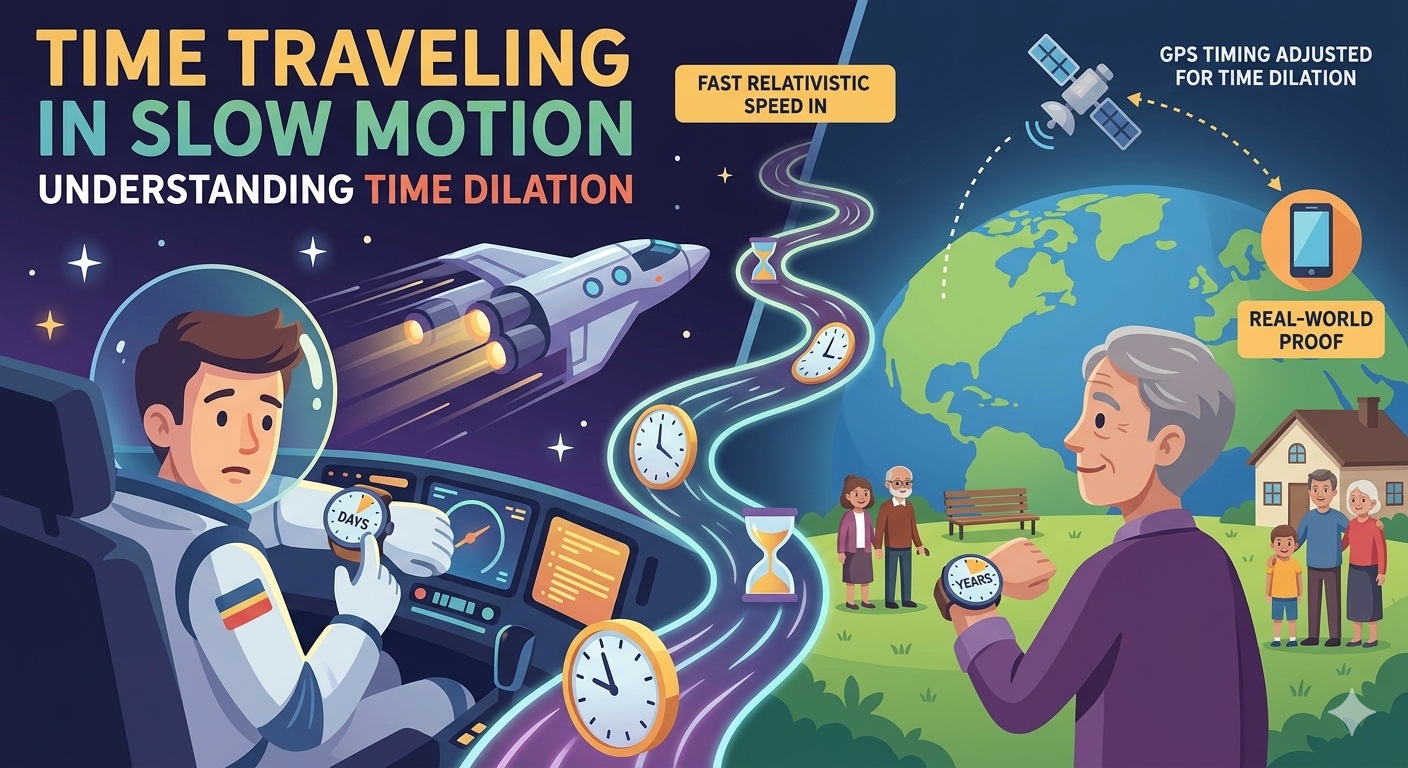
Imagine you and your best friend buy two identical, perfectly synced wristwatches. You stay on Earth, but your friend hops into a spaceship and zooms away at nearly the speed of light. When they return a few years later, you notice something shocking: your friend’s watch shows that only a few days have passed, and they look younger than you.
This isn't a movie plot. It is a proven fact of our universe called time dilation.
To a student encountering physics for the first time, this sounds impossible. We are used to thinking of time as a steady river that flows at the exact same speed for everyone. But according to Albert Einstein's time dilation theory, time is flexible.
The Fabric of the Universe: Space and Time Joined
To understand how time can stretch, we have to change how we view the universe. For a long time, scientists thought space was just an empty stage where events happened, and time was an independent clock ticking away in the background. That changed in the early 1900s.
Who said the 4th dimension is time?
Physicist Hermann Minkowski, who was actually one of Einstein's professors, realized that space and time cannot be separated. He showed that our world has three dimensions of space (up/down, left/right, forward/backward) and a fourth dimension: time. Together, they form a single fabric called spacetime.
How Does Special Relativity Explain Time Dilation?
Einstein’s Special Theory of Relativity relies on one golden rule: the speed of light is the absolute cosmic speed limit, and it never changes.
No matter how fast you are moving toward a beam of light, or how fast the light source is moving away from you, light always travels at roughly 300,000 kilometers per second.
Because the speed of light must remain constant for everyone, something else has to give way. That "something" is time itself. If you move incredibly fast through space, your motion through time has to slow down so that the speed of light stays the same.
The Math Behind the Magic
You don't need a PhD to understand how physicists calculate this stretching of time. Scientists use a specific mathematical tool called the time dilation formula.
The formula looks like this:
Let's break down what these symbols mean using simple terms:
- t = Time measured by the outside observer
- t₀ = Time measured by the moving observer
- v = Speed of the moving object
- c = Speed of light
- √ = Square root symbol
When you do a time dilation calculation, you notice that if your speed (v) is small—like driving a car—the fraction v² / c² is so tiny that it is basically zero. Because of this, time moves normally for us in daily life.
However, as your speed (v) gets closer to the speed of light (c), the value of the bottom part of the fraction gets smaller, causing the total time (t) to grow much larger.
Proof That It's Real: Not Just Sci-Fi
It is natural to ask: Did Einstein prove time dilation? Einstein figured it out using mathematics and thought experiments in 1905, but he didn't have the technology to physically prove it at the time. Decades later, other scientists built tools advanced enough to test his ideas. Every single test has proven Einstein right.
A Time Dilation Real Life Example: GPS Satellites
You actually use the reality of time dilation every time you look at a digital map on your phone. The Global Positioning System (GPS) relies on satellites orbiting high above Earth. Because these satellites move very fast relative to the ground, their onboard atomic clocks tick slower by about 7 microseconds every day compared to clocks on Earth.
If engineers didn't use Einstein's equations to constantly adjust these satellite clocks, your GPS location would become inaccurate by several kilometers in just one day!
The Flying Clock Experiment
Another famous example of time dilation occurred in 1971 (the Hafele-Keating experiment). Scientists put highly accurate atomic clocks onto commercial airplanes and flew them around the world. When the planes landed, the clocks that traveled at high speeds were slightly behind the clocks that stayed steady on the ground.
Taking It to the Extreme: The Cosmic Speed Limit
What happens when we leave Earth and look at time dilation in space?
Astronauts living on the International Space Station (ISS) are orbiting Earth at speeds of about 28,000 kilometers per hour. Because of this speed, they are technically time traveling into the future, aging a fraction of a second slower than people on the ground.
What is the Time Dilation at 99.9% the Speed of Light?
If we could build a spaceship that travels near the cosmic speed limit, the effects become dramatic. Let's do a quick mental calculation. If you travel at 99.9% of the speed of light to a star system and back, the time dilation factor is about 22.
- For every 1 year that passes for you inside the ship, 22 years pass for your friends back on Earth.
- If you take a 5-year journey from your perspective, you will return home to find that 110 years have passed on Earth.
You would step out of your ship looking just a few years older, while generations of your family had lived out their entire lives.
Quick Summary for Students
- Time is relative: It changes depending on how fast you are moving.
- The Cause: Because the speed of light is always constant, time must bend when objects move incredibly fast.
- The Rule: The faster you move through space, the slower you move through time.