Why Is the Electric Field Inside a Conductor Zero? (Full Explanation with Gauss's Law)
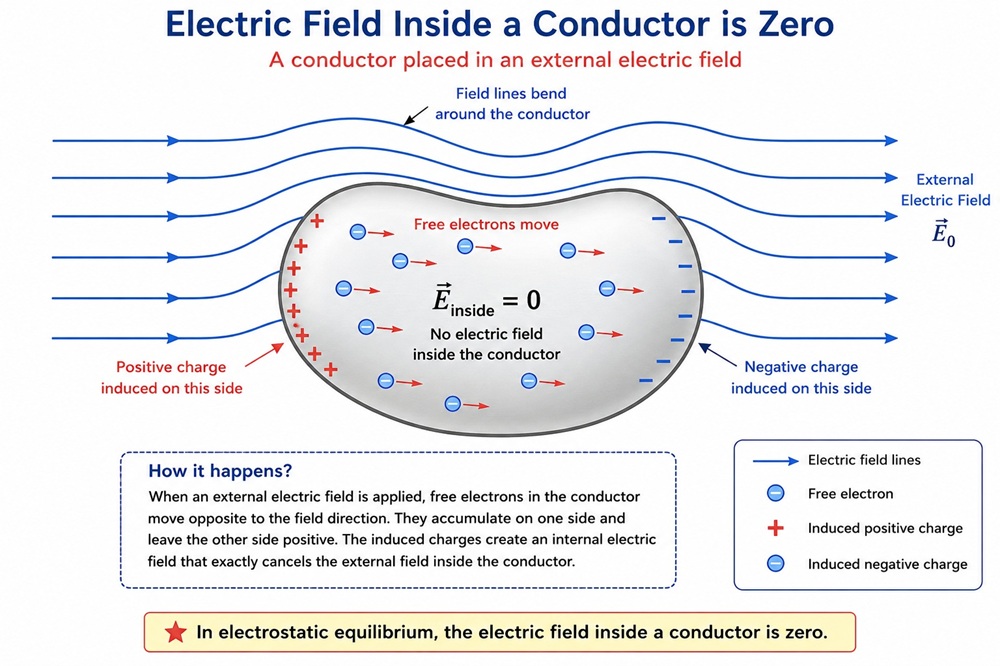
The electric field inside a conductor is zero because free electrons inside it move and pile up until they create their own field that exactly cancels any outside field. Once that happens, the electrons stop moving, and the conductor reaches what physicists call electrostatic equilibrium. This is why a metal car protects you from lightning and why charges always sit on the surface of a conductor, never inside.
Introduction
Here's a strange fact: if lightning strikes a car, the people inside usually walk away unharmed. The car's metal body carries a massive electric charge for a split second, yet the air inside the cabin stays completely calm. No shock, no spark, nothing.
The reason comes down to one core idea in electrostatics: the electric field inside a conductor is zero. This isn't a rule someone made up. It's a direct result of how free electrons behave when you place a conductor near an electric field.
In this post, you'll see exactly why this happens, how to prove it using Gauss's law, when the rule has limits, and how to write a clean answer for your Class 12 or JEE exam. By the end, you'll understand this concept well enough to explain it in your own words, not just recall it.
What Is the Electric Field Inside a Conductor?
A conductor is any material, usually a metal, where electrons aren't tightly locked to individual atoms. These "free electrons" can drift through the material almost like a gas moving inside a container. This is different from an insulator, where electrons stay bound to their atoms and can't move freely.
The electric field inside a conductor refers to the net electric field at any point within the bulk of that material, not on its surface. When physicists say this field is zero, they mean: if you placed a tiny test charge somewhere inside the metal, it would feel no net electric force at all.
This matters because it explains a lot of real-world behavior, from why electrical wiring is safe to touch on the outside to why your phone's metal frame doesn't interfere with the circuits packed inside it.
Why Is the Electric Field Inside a Conductor Zero?
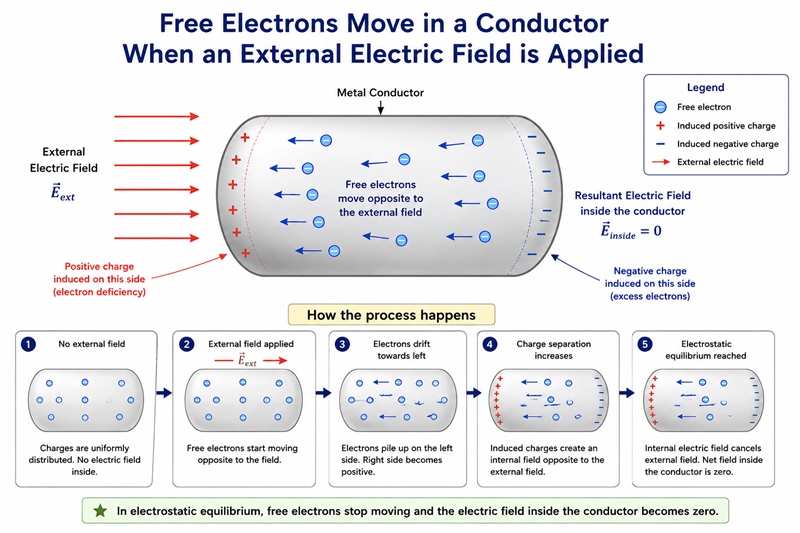
The electric field inside a conductor is zero because free electrons rearrange themselves until they produce an internal field that exactly cancels out any external field. This happens automatically, almost instantly, whenever a conductor is placed near a charge or in an external field.
Here's the step-by-step logic:
- An external field is applied. Say you bring a positively charged rod near a neutral metal sphere.
- Free electrons respond. Since electrons are negative, they get pulled toward the positive rod. They drift toward the near side of the conductor.
- Charge builds up unevenly. The side facing the rod becomes slightly negative (extra electrons), and the far side becomes slightly positive (electron-deficient).
- This separation creates its own field. The displaced charges generate an internal electric field pointing in the opposite direction to the external one.
- Electrons keep moving until the fields cancel. As long as there's any leftover field inside the conductor, free electrons keep experiencing a force and keep moving. They only stop when the internal field produced by the rearranged charges exactly matches and cancels the external field.
At that point, the net field inside is zero, and the electrons have no reason to move any further. This isn't a temporary or approximate cancellation. It's exact, because even a tiny leftover field would keep pushing electrons until it disappeared too.
A simple way to picture this: imagine pouring water into a container with a paddle wheel inside. The water (electrons) will keep flowing and turning the wheel as long as there's a slope (electric field) pushing it. Once the water settles to a flat, even level, there's no more slope, and the flow stops. The conductor's electrons behave the same way, settling until there's no "slope" left to push them.
What Is Electrostatic Equilibrium?
Electrostatic equilibrium is the stable state a conductor reaches when its free charges have completely stopped moving. At this point, the electric field inside the conductor is exactly zero, and every point on its surface is at the same electric potential.
This state isn't instantaneous in a literal sense, but for normal conductors like copper or aluminum, it happens incredibly fast, within a tiny fraction of a second. Once equilibrium is reached, nothing changes unless you alter the external field or bring the conductor into contact with a new charge.
Two conditions define electrostatic equilibrium clearly:
- No net motion of charge. If there were still a field inside, electrons would keep accelerating, and the system wouldn't be at rest.
- Uniform potential throughout. Since the field inside is zero, moving a charge from one point inside the conductor to another takes no work. That means every interior point, and the surface itself, sits at the same potential.
This second point is genuinely useful for solving problems. If you know the electric field inside a conductor is zero, you immediately know the potential doesn't change as you move from the center to the edge.
Proving It with Gauss's Law
You can prove the electric field inside a conductor is zero by drawing an imaginary closed surface, called a Gaussian surface, entirely inside the conductor and applying Gauss's law to it.
Gauss's law states that the total electric flux through any closed surface equals the net charge enclosed by that surface, divided by a constant (the permittivity of free space). In equation form:
Φ = Q_enclosed / ε₀
Now picture a charged conducting sphere. Draw a Gaussian surface inside it, somewhere between the center and the actual surface of the sphere, like a smaller sphere nested inside the real one.
Here's the key insight: in a conductor at electrostatic equilibrium, all the excess charge sits on the outer surface. None of it sits inside the bulk of the material. So whatever Gaussian surface you draw inside the conductor encloses zero net charge.
Since the enclosed charge is zero, Gauss's law tells you the total flux through that surface must also be zero. And because you can shrink or expand this imaginary surface to any size or shape as long as it stays inside the conductor, the only way the flux can always come out to zero is if the electric field itself is zero everywhere inside.
This is a neat example of how one physical fact (no charge inside) and one mathematical law (Gauss's law) combine to prove something that would be hard to demonstrate experimentally point by point.
Why Charges Stay on the Surface, Not Inside
Charges stay on the surface of a conductor, not inside it, because like charges repel each other and naturally spread as far apart as possible. Since all the charge is the same sign (say, all extra electrons), every charge pushes every other charge away.
The surface is the only place where charges can spread out and still stay within the conductor. Moving toward the surface increases the average distance between charges, which lowers the total electrostatic energy of the system. Nature tends toward the lowest energy state available, so the charges settle there and stay.
This also lines up with what Gauss's law showed in the previous section. If there were any leftover charge sitting inside the bulk of the conductor, it would create a field inside, which contradicts the zero-field condition you just proved. So the two ideas, energy minimization and Gauss's law, both point to the same conclusion from different directions.
Real-Life Examples of Electrostatic Shielding
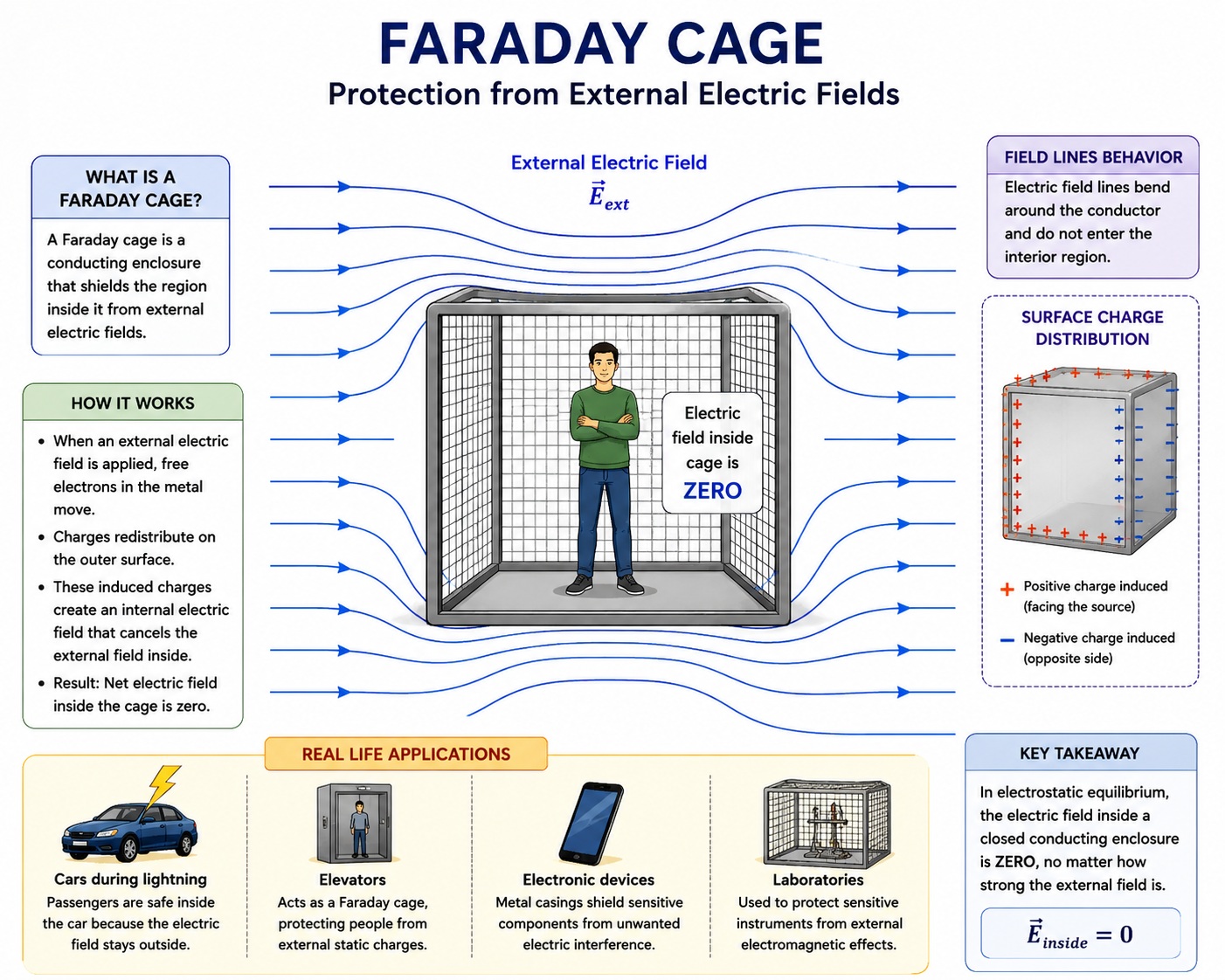
This zero-field property isn't just a textbook result. It shows up in several everyday situations where conductors protect whatever is inside them from outside electric fields:
- Cars during lightning strikes. A car's metal body acts as a conductor. When lightning hits, the charge redistributes across the outer surface of the car, and the field inside the cabin stays close to zero. This is part of why people inside a car are relatively safe during a lightning strike, though the tires and rubber aren't the actual reason, the metal shell is.
- Faraday cages. A Faraday cage is a metal enclosure, often a mesh or wire frame, built specifically to block external electric fields. Sensitive electronic equipment is sometimes housed inside one to prevent outside interference from reaching the components inside.
- Aircraft and lightning protection. Airplanes are struck by lightning more often than most people realize. The aluminum skin of the aircraft conducts the charge around the outside and off the plane, keeping passengers and onboard electronics shielded from the field.
- Elevators and metal-walled rooms. This is also why phone signal sometimes drops in elevators or rooms with a lot of metal in the walls. The metal forms a partial shield, blocking external electromagnetic fields, including radio signals, from reaching the inside.
These examples all rely on the same underlying physics: a conductor's free charges rearrange to cancel the field inside it, protecting whatever is enclosed.
Is the Electric Field Inside a Conductor Always Zero?
The electric field inside a conductor is zero only under electrostatic conditions, meaning the charges are at rest with no current flowing. If current is flowing through the conductor, there's actually a small electric field inside it, and that field is what drives the current.
This distinction trips up a lot of students, so it's worth being precise about it:
- Electrostatics (no current): Charges have settled into equilibrium. The field inside is exactly zero. This is the situation covered in most Class 12 and JEE questions about conductors.
- Current-carrying conductors: A battery or power source maintains a potential difference across the conductor. This creates a small, steady electric field inside the wire, and that field is precisely what pushes the free electrons along to produce current. Without some field, there would be no force to keep the charges moving, and the current would stop.
So when you see this rule stated in a textbook, it almost always assumes "electrostatic conditions" even if those exact words aren't written out. If a question mentions current flow, resistance, or a circuit, the zero-field rule for conductors no longer applies in the same way.
How to Answer This in Your JEE or Class 12 Exam
2-Mark Answer
In a conductor placed in an external electric field, free electrons shift until they create an internal field that exactly cancels the external one. Once this cancellation is complete, the net electric field inside the conductor becomes zero. This condition is called electrostatic equilibrium, and the excess charge resides only on the conductor's surface.
5-Mark Answer
When a conductor is placed in an external electric field, its free electrons experience a force and begin to move. Electrons drift toward the side facing the field, leaving the opposite side with a deficit of electrons. This charge separation produces an induced electric field inside the conductor, directed opposite to the external field.
As long as any net field remains inside the conductor, free electrons continue to experience a force and keep redistributing. This process continues until the induced field exactly equals and opposes the external field, at which point the net field inside becomes zero. The conductor has now reached electrostatic equilibrium, and the charge distribution stops changing.
This can be proven using Gauss's law. Drawing a Gaussian surface entirely inside the conductor, the enclosed charge is always zero, because all excess charge resides on the conductor's surface. Since Φ = Q_enclosed / ε₀, zero enclosed charge means zero net flux, and therefore the electric field at every point inside the conductor must be zero.
A useful consequence of this result is that the entire conductor, from its center to its surface, sits at the same electric potential, since no work is needed to move a charge through a region of zero field.
It's worth noting that this result applies specifically to electrostatic conditions. In a current-carrying conductor, a small internal electric field exists and is responsible for driving the current.
Conclusion
The electric field inside a conductor is zero because free electrons don't sit still when there's a field pushing on them. They shift position, build up charge on the surface, and create their own opposing field, until the two fields cancel out completely. That stable, no-further-movement state is electrostatic equilibrium, and it's the reason metal enclosures can shield you from lightning, block stray fields, and keep sensitive electronics safe.
The one exception worth remembering: this rule holds for electrostatics, not for conductors carrying current, where a small internal field is exactly what keeps the current flowing.
If you're working through electrostatics for your boards or JEE prep, it helps to see how this idea connects to other foundational concepts. Take a look at our breakdown of Coulomb's law practice problems for more worked examples, or explore how charges interact in electric fields to build on what you've learned here.
Frequently Asked Questions
Why is the electric field inside a conductor zero?
Free electrons inside the conductor move and redistribute themselves whenever an external field is applied. This movement continues until the induced field they create exactly cancels the external field, leaving zero net field inside. This stable state is called electrostatic equilibrium.
Is the electric field inside a conductor always zero?
No, only under electrostatic conditions, meaning no current is flowing. If current flows through the conductor, a small internal electric field exists and is what drives that current.
What happens to charges placed inside a conductor?
Charges placed inside a conductor don't stay inside. They move to the outer surface almost immediately, because like charges repel each other and spreading out toward the surface lowers the system's overall energy.
Why do charges stay on the surface of a conductor and not inside?
Charges stay on the surface because mutual repulsion pushes them as far apart as possible, and the surface offers the maximum possible separation within the conductor's boundary. This also satisfies Gauss's law, which requires zero net charge inside the conductor for the internal field to be zero.
What is electrostatic shielding?
Electrostatic shielding is the effect where a conductor blocks external electric fields from reaching its interior. Since the field inside a conductor at equilibrium is zero, anything enclosed within it, like passengers in a car or electronics in a Faraday cage, is protected from outside fields.